The woman behind the family story
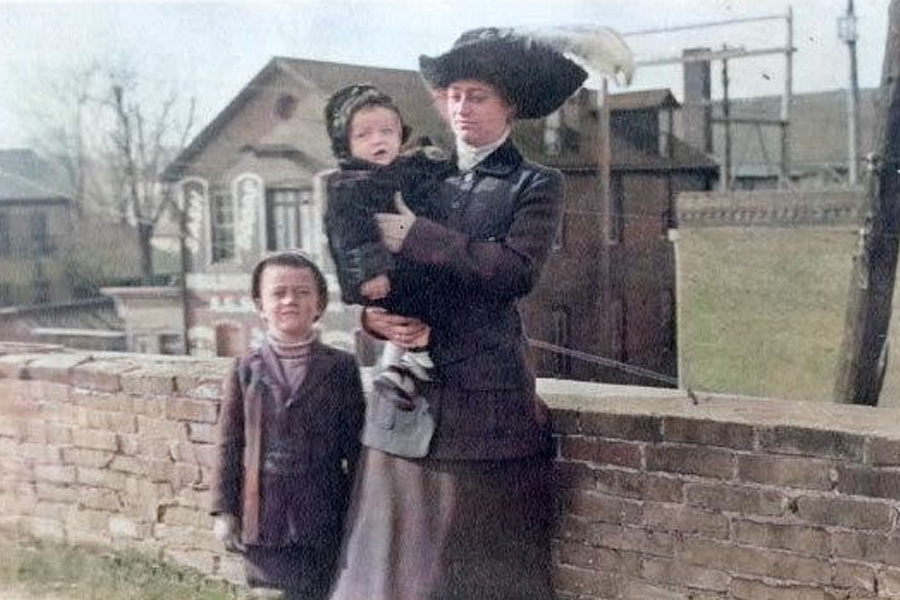
I see Mary Alberta Brown as one of those figures who rarely stand in the spotlight, yet shape the whole stage. Her name appears in family history as Mary Alberta Brown, Mary Morrison, Mary Alberta Brown Morrison, and Mary Alberta Brown Preen. That shifting name trail tells me something important. She lived through marriages, moves, children, loss, and reinvention. Her life was not built from headlines. It was built from household weather, from steady work, from church life, from children growing into their own destinies.
Her birth is usually placed in 1885, though the exact date varies in public family records. Her death is consistently given as 17 March 1970. That single span, from the late nineteenth century into the modern age, places her across an era of horses, telephones, World War I, the rise of movies, and the long cultural shadow of the American West. She belonged to a time when a woman could hold a family together without ever being fully seen. That is the kind of life I find most revealing.
Mary is best remembered as the mother of John Wayne, one of the most recognizable names in American film history. But that description is too narrow. She was also the wife of Clyde Leonard Morrison, later the wife of Sydney David Preen, the daughter of Robert Emmet Brown and Margaret Moran or a closely related variation of that name, and the mother of Robert Emmett Morrison as well as John Wayne, born Marion Robert Morrison. Through those lines, she became the center of a large and far reaching family tree.
Marriage, children, and the architecture of home
The 1905 Knoxville, Iowa marriage of Mary and Clyde Leonard Morrison was her first. She started her adulthood with this marriage. Despite Clyde’s pharmacy career, the household struggled. According to family history, money was scarce and life unpredictable. I imagine a home where every choice counted and stability was built day by day.
That marriage has two sons.
John Wayne, born Marion Robert Morrison in 1907, was the family’s famous figure. He rose to fame in American movies with grit, authority, and a voice like a fence line in a dry breeze. The woman behind that enormous image kept the sons clean, presentable, and rooted.
Robert Emmett Morrison, born in 1911, was little known. His family status affects. Every tree has shaded and lit branches. Robert was one of the latter, but it doesn’t diminish him. It means the historical lens was pointed elsewhere.
Later, Mary married Sydney David Preen in 1930. Life changed with this second marriage, suggesting resilience rather than retreat. She played multiple roles. She advanced. Her shape changed. Like many ladies her age, she adapted.
Family members and the long reach of her name
When I look at Mary Alberta Brown’s family, I see a network that spreads like roots under dry ground. Some names are famous, others are known mostly inside family history, but all belong to the same living line.
Her husband, Clyde Leonard Morrison, was the father of her two sons and the earliest partner in her adult story. His work as a pharmacist and the family’s financial struggles made him part of the domestic tension of the era. He died in 1937.
Her later husband, Sydney David Preen, entered her life after the first family chapter had already taken shape. He died in 1982.
Her son John Wayne stands at the center of the family’s public identity. Through him, Mary became the grandmother of seven children. Those grandchildren are Michael Wayne, Mary Antonia Wayne LaCava, Patrick Wayne, Melinda Wayne Munoz, Aissa Wayne, John Ethan Wayne, and Marisa Wayne. That is a large, branching inheritance. One life becomes many lives. One woman becomes a source line for an entire generation.
From the information provided, the family also reaches further into later generations. Mary is linked as a great grandmother to Duke Morrison Ditteaux, Anita Swift, David LaCava, Christopher LaCava, Anastasia Pilar Gionis, Melanie Wayne, Teresa Wayne, and Matthew Munoz. These names show how a family keeps moving. Even when a person is long gone, the name travels forward, passing from memory to memory like a lantern in the dark.
I think that is what family history really is. Not just names in a ledger. It is pressure and inheritance, similarity and distance, repeated features of face and temperament, and the quiet fact that one person’s choices can shape many descendants she never met.
Career, character, and the practical work of survival
Mary’s public career is brief, although she was a Des Moines telephone operator. That task is more important than it seems. A telephone operator was part of modern life’s nerve system. She linked distant people. She was literally a bridge.
Her greatest legacy was human, not corporate or financial. She was organized, determined, and involved in local politics in family history. She valued presentation, discipline, and dignity. Not minor stuff. Dignity can support a financially strapped family.
I don’t see wealth in her story. What I observe is adaptation. Insufficiently successful husband. Household that stretched. A westward motion. Mother who kept her kids together during turmoil. That work rarely appears on plaques. Still, it influences a life like any public accolade.
Mary’s place in the larger story
Mary Alberta Brown matters because she sits at the intersection of ordinary life and public myth. The myth is John Wayne. The ordinary life is everything that made John Wayne possible. A mother can influence a future without ever stepping into the frame. She can form habits, standards, and outlooks that outlast her own daily world.
I find her story especially vivid because it is so human. There is no single dramatic event that explains her life. Instead there is a chain of moments: a marriage in 1905, the birth of a son in 1907, another in 1911, a second marriage in 1930, a husband’s death in 1937, her own death in 1970. These dates form a skeleton. Around them hangs the flesh of private life.
She lived long enough to see her son become a legend and her grandchildren carry the line forward. That alone makes her story worth telling. A woman can be both hidden and foundational. Mary Alberta Brown was that kind of woman.
FAQ
Who was Mary Alberta Brown?
Mary Alberta Brown was the mother of John Wayne and Robert Emmett Morrison, the first wife of Clyde Leonard Morrison, and later the wife of Sydney David Preen. She was also a telephone operator and a family matriarch whose life shaped a large multigenerational lineage.
When was Mary Alberta Brown born and when did she die?
Her birth is generally placed in 1885, though the exact date varies in public family records. Her death is consistently listed as 17 March 1970.
Who were Mary Alberta Brown’s children?
She had two sons: John Wayne, born Marion Robert Morrison, and Robert Emmett Morrison.
Who was Mary Alberta Brown’s first husband?
Her first husband was Clyde Leonard Morrison. They married in 1905 and had two sons together.
Did Mary Alberta Brown marry again?
Yes. She later married Sydney David Preen in 1930.
Who are Mary Alberta Brown’s grandchildren?
Her grandchildren through John Wayne are Michael Wayne, Mary Antonia Wayne LaCava, Patrick Wayne, Melinda Wayne Munoz, Aissa Wayne, John Ethan Wayne, and Marisa Wayne.
Why is Mary Alberta Brown important?
She matters because she was the family center behind one of America’s most famous screen legends. Her life also reflects the hard, steady work of women who held families together through change, money trouble, and reinvention.