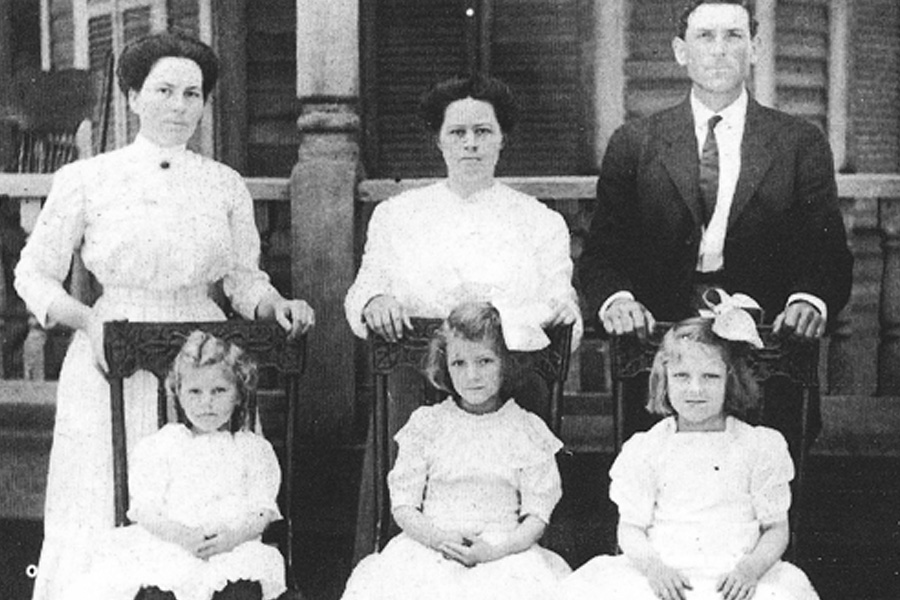
A life rooted in land, labor, and loss
When I look at Jonas Bailey Gardner, I do not see a man built for easy weather. I see a North Carolina farmer born on 30 October 1878, shaped by fields, seasons, debts, weather, and the stubborn arithmetic of family life. His story is not loud. It is not polished. It moves like a dirt road after rain, slow and uneven, but it leaves a deep track.
Jonas was born in the late nineteenth century in the Saratoga and Wilson County region of North Carolina. By the time he reached adulthood, the world around him was already changing. Farming still stood at the center of life, yet the old confidence of land ownership could vanish quickly. For Jonas, land was both shelter and burden. It offered the promise of independence, but it also demanded labor without mercy. That tension sits at the center of his biography.
I see him first as a farmer, then as a husband, then as the father of a large household that would later become more famous than the man himself. He married Mary Elizabeth Baker, known in family memory as Mollie, on 21 January 1903. Their marriage became the spine of a big family, one that stretched across decades and across several hard turns in American rural life.
The Gardner household and the people around Jonas
The Gardner family was not small, quiet, or fragile. It was a crowded world of children, chores, and constant motion. Jonas and Mary Elizabeth had seven children, and each one carried a piece of the family’s story forward.
| Family member | Relationship to Jonas | Notes |
|---|---|---|
| James Bailey Gardner | Father | Born 1828, died 1902 |
| Mary Elizabeth Dilda | Mother | Born 1850, died 1922 |
| Mary Elizabeth Baker “Mollie” Gardner | Wife | Married Jonas on 21 January 1903 |
| Beatrice Elizabeth Gardner Cole | Daughter | Born 1903, died 1993 |
| Elsie Mae Gardner Creech | Daughter | Born 1904, died 1987 |
| Edna Inez Gardner Grimes | Daughter | Born 1906, died 1981 |
| Raymond Allison Gardner | Son | Born 1908, died 1911 |
| Jonas Melvin “Jack” Gardner | Son | Born 1911, died 1981 |
| Myra Merritt Gardner Pearce | Daughter | Born 1915, died 2005 |
| Ava Lavinia Gardner | Daughter | Born 1922, died 1990 |
Jonas’s father, James Bailey Gardner, died in 1902. Mother Mary Elizabeth Dilda, born 1850, died 1922. Jonas comes from a lengthy rural heritage that spans the Civil War and the unsettling modern South.
Mary Elizabeth Baker, born in 1883 and died in 1943, was more than a spouse. The Gardner family relied on her as the home’s center when the ground shifted. Jonas married early in adulthood on January 21, 1903, starting a home that would be tested often.
The first child was Beatrice Elizabeth Gardner Cole, born in 1903. I see her arriving when the young marriage found its groove. Elsie Mae Gardner Creech (1904) and Edna Inez Gardner Grimes (1906) followed. The house would have been full of little voices and practical tasks by then.
Raymond Allison Gardner (1908–1911) followed. His brief life is one of the heartbreaking, quiet realities that show how vulnerable families were then. Loss was normal. The landscape included it.
Jack, born Jonas Melvin Gardner in 1911, followed Raymond. The family chronicle becomes more informal and human with that nickname. Nicknames keep the warmth of daily living whereas family names harden on paper.
After Myra Merritt Gardner Pearce in 1915, Ava Lavinia Gardner, the youngest and most famous, was born on 24 December 1922. Ava would become a famous actress, but she was the last child in a large, hardworking Gardner family, born into a world that had transformed under Jonas.
A farmer’s career and the economics of survival
Jonas Bailey Gardner’s work life was defined by agriculture. He was a farmer, and that word should not be treated lightly. Farming in early twentieth century North Carolina was not a romantic field scene. It was labor that soaked through clothing and habit alike. It meant debt, weather risk, crop uncertainty, and long days with little reward.
At one point, Jonas built a two story house for the family after land purchases in Johnston County. That detail matters because it shows ambition. He was not merely surviving. He was trying to make something lasting. A house like that is more than timber and nails. It is a statement that says a family belongs somewhere.
But the land did not stay secure. Crop failures and boll weevil damage tore through the family economy. Over time, the Gardners lost their property and became tenant farmers. That change is one of the sharpest turns in Jonas’s life. Ownership slipped into dependence. The house remained in memory, but the stability attached to it did not.
Later accounts also place Jonas working at a sawmill. That kind of shift was common for rural men whose farms could no longer carry the burden of survival. The sawmill was not a step up in romance or status. It was a different sort of hard. It meant taking strength that once belonged to the field and applying it to timber, machinery, and repetitive labor.
I read Jonas’s career as a story of endurance more than advancement. He did not leave behind a long paper trail of titles or offices. His work achievement was the ability to keep a large family moving through instability. In many lives, that is the real ledger.
A family shaped by movement and adjustment
The Gardner family moved around. The family moved to Newport News, Virginia, after years of farm pressure and economic duress. Jonas was sick after Mary Elizabeth ran a boardinghouse. The move changes the family story again. It reminds us that rural families had to move to survive.
The family relocated to Rock Ridge near Wilson, North Carolina, after Jonas died in Newport News on March 26, 1938. Death did not terminate family history. It restructured. The children continued the name, and Mary Elizabeth preserved the family memory.
Jonas lived a simple existence, but he helped build a family beyond the farm. Each of Beatrice, Elsie, Edna, Raymond, Jonas Melvin, Myra, and Ava’s families faced hardship and resilience. Their lives built a sandy-soil family tree with branches into American history.
Why Jonas Bailey Gardner still matters
I think Jonas Bailey Gardner matters because his life reflects a whole class of American experience that often disappears behind celebrity stories and polished biographies. He was a father, a farmer, a husband, a landholder, a tenant, and later a laborer. He was a man whose life was measured in acres, children, crop cycles, and family transitions.
His story is also powerful because it is unfinished in the human way. We know enough to see the shape of it, but not so much that it loses its mystery. He stands in family memory as a practical, working man whose choices were made under pressure. That gives his biography a rough, honest texture. It feels like a hand tool with the handle worn smooth.
FAQ
Who was Jonas Bailey Gardner?
Jonas Bailey Gardner was a North Carolina farmer born on 30 October 1878 and died on 26 March 1938. He is also remembered as the father of seven children, including actress Ava Gardner.
Who was Jonas Bailey Gardner’s wife?
His wife was Mary Elizabeth Baker, also known as Mollie Gardner. They married on 21 January 1903.
How many children did Jonas Bailey Gardner have?
He had seven children: Beatrice Elizabeth, Elsie Mae, Edna Inez, Raymond Allison, Jonas Melvin, Myra Merritt, and Ava Lavinia.
What kind of work did Jonas Bailey Gardner do?
He worked primarily as a farmer. After the family lost their land, later accounts place him working at a sawmill as well.
What happened to the Gardner family land?
The family reportedly built a two story house on their land in Johnston County, but crop failures and boll weevil damage eventually caused them to lose the property and become tenant farmers.
Where did Jonas Bailey Gardner die?
He died in Newport News, Virginia, on 26 March 1938.
Why is Jonas Bailey Gardner remembered today?
He is remembered both as a rural North Carolina family patriarch and as the father of a famous daughter, Ava Gardner. His life also reflects the struggles of working farm families in the early twentieth century.